
Table of Contents
ToggleA Complete Guide for Industrial Buyers, Engineers, and Manufacturers
In industries where strength, durability, and reliability are critical, forging remains one of the most trusted manufacturing methods. From automotive components and construction equipment to aerospace parts and heavy engineering machinery, forged components are known for their superior mechanical properties and long service life.
Among the various forging methods available today, drop forging is one of the most widely used processes for manufacturing high-strength metal components with precise shapes and consistent quality.
But what exactly is drop forging? How does the process work? What are its advantages, applications, and different types?
In this comprehensive guide, we’ll explore everything you need to know about drop forging and why leading industrial companies rely on experienced Forging Manufacturers and Rolled Ring Forging Manufacturers to deliver mission-critical forged components.
What Is Drop Forging?
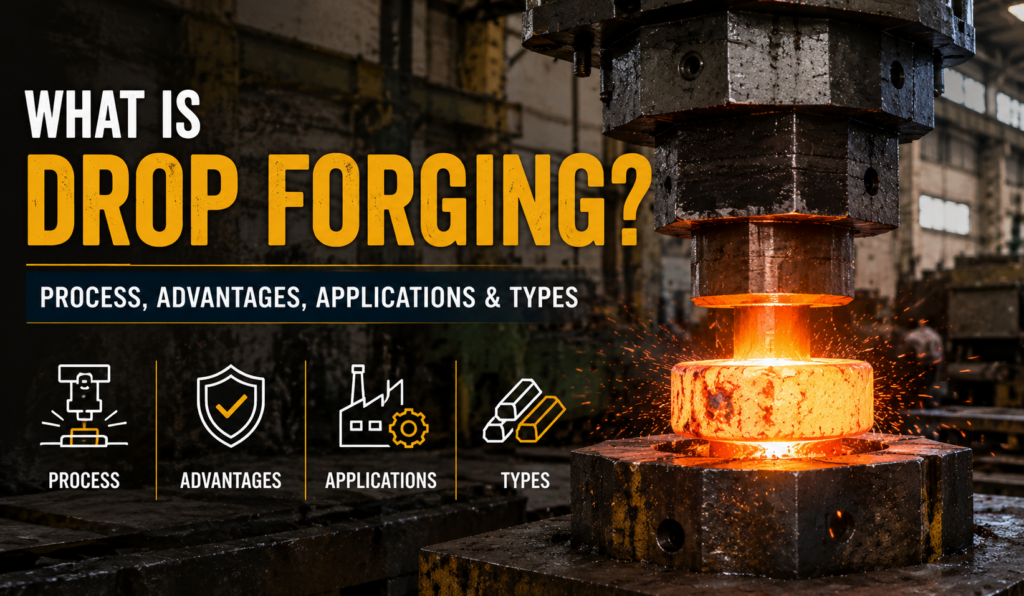
Drop forging is a metal forming process in which a heated metal workpiece is shaped between two dies by repeated hammer blows or compressive force. The upper die is dropped onto the heated material, causing the metal to flow and fill the die cavity.
The process derives its name from the action of “dropping” a hammer onto the metal workpiece. Modern drop forging operations often use mechanical, hydraulic, or power hammers to generate the required force.
The result is a forged component with:
- Superior strength
- Improved grain structure
- High impact resistance
- Excellent fatigue performance
- Consistent dimensional accuracy
Drop forging is commonly used to manufacture parts that must withstand heavy loads and demanding operating conditions.
How Does the Drop Forging Process Work?
The drop forging process involves several carefully controlled steps to ensure consistent quality and performance.
Step 1: Material Selection
The process begins with selecting the appropriate metal based on application requirements.
Common forging materials include:
- Carbon steel
- Alloy steel
- Stainless steel
- Aluminum alloys
- Titanium alloys
- Nickel-based alloys
Material selection directly impacts the component’s strength, toughness, and corrosion resistance.
Step 2: Heating the Metal
The metal billet or bar is heated to a specific forging temperature to improve ductility and make deformation easier.
Proper temperature control is essential because:
- Excessive temperatures can cause grain growth and oxidation.
- Insufficient temperatures can result in cracking and poor material flow.
Step 3: Placing the Work piece in the Die
The heated work piece is positioned between the upper and lower forging dies.
These dies contain the shape of the final component.
Step 4: Applying the Forging Force
The hammer or press applies force to the work piece, causing the metal to flow into the die cavity.
Depending on the component geometry, multiple blows may be required to achieve the final shape.
Step 5: Trimming Excess Material
Excess metal, known as flash, is removed after forging.
This step improves dimensional accuracy and prepares the component for finishing operations.
Step 6: Heat Treatment and Finishing
After forging, components may undergo:
- Heat treatment
- Machining
- Surface finishing
- Non-destructive testing
- Dimensional inspection
These processes ensure the final component meets customer specifications and industry standards.
Types of Drop Forging
Different types of drop forging are used depending on component requirements and production volume.
- Open Die Drop Forging
In open die forging, the workpiece is compressed between flat or simple dies without being fully enclosed.
Benefits:
- Suitable for large components
- Greater flexibility
- Lower tooling costs
Common Applications:
- Shafts
- Large rings
- Heavy machinery parts
- Industrial forgings
- Closed Die Drop Forging
Also known as impression die forging, this method uses dies with specially shaped cavities.
The metal is forced to flow into the die cavity to create precise component shapes.
Benefits:
- High production efficiency
- Better dimensional accuracy
- Reduced machining requirements
Common Applications:
- Automotive parts
- Aerospace components
- Industrial machine parts
- Bearing components
- Precision Drop Forging
Precision forging produces near-net-shape components that require minimal machining.
Benefits:
- Lower material waste
- Reduced production costs
- Improved accuracy
Applications:
- High-performance engineering components
- Aerospace systems
- Automotive assemblies
Advantages of Drop Forging
Drop forging offers numerous advantages over casting, welding, and machining from solid stock.
Superior Mechanical Strength
The forging process refines the metal’s grain structure and aligns grain flow with the shape of the component.
This results in:
- Higher tensile strength
- Better fatigue resistance
- Improved impact toughness
Enhanced Structural Integrity
Forged components contain fewer internal defects than cast components.
Benefits include:
- Reduced porosity
- Lower risk of voids
- Improved reliability
Excellent Durability
Drop-forged parts perform exceptionally well under:
- Heavy loads
- Repetitive stress
- Harsh operating environments
This makes them ideal for demanding industrial applications.
Better Material Utilization
Compared to machining from solid material, forging reduces waste and improves material efficiency.
Consistent Product Quality
Modern forging facilities use advanced controls to ensure repeatability and consistent quality across production batches.
Limitations of Drop Forging
While drop forging offers many advantages, it is important to understand its limitations.
Higher Tooling Costs
Custom dies must be manufactured for each component design.
This makes drop forging more economical for medium to high production volumes.
Design Constraints
Complex geometries may require multiple forging stages or additional machining.
Size Limitations
Very large components may be better suited to open die forging or ring rolling processes.
Common Applications of Drop Forging
Drop forging is used across a wide range of industries because of its ability to produce strong and reliable components.
Automotive Industry
Examples include:
- Connecting rods
- Crankshafts
- Steering components
- Suspension parts
Aerospace Industry
Forged aerospace components require:
- High strength
- Low weight
- Excellent fatigue resistance
Applications include:
- Landing gear components
- Structural brackets
- Engine parts
Construction Equipment
Heavy-duty equipment relies on forged parts for:
- Excavators
- Loaders
- Cranes
- Earthmoving machinery
Oil & Gas Industry
Forged components are used in:
- Valves
- Flanges
- Pressure equipment
- Drilling systems
Railway Industry
Drop-forged parts contribute to:
- Safety
- Reliability
- Long service life
Common examples include couplings, brackets, and structural components.
Drop Forging and Seamless Rolled Rings
While drop forging is ideal for producing many industrial components, certain applications require large-diameter rings with exceptional structural integrity.
In such cases, manufacturers often use ring rolling technology to produce a Seamless Rolled Ring.
A seamless rolled ring offers:
- Continuous grain flow
- Improved fatigue resistance
- High load-bearing capability
- Better material utilization
Industries using seamless rolled rings include:
- Wind energy
- Mining
- Aerospace
- Marine engineering
- Power generation
- Bearing manufacturing
This is where a specialized Rolled Ring Forging Manufacturer provides significant value through advanced forging and ring rolling expertise.
Why Choosing the Right Forging Manufacturer Matters
The quality of a forged component depends not only on the forging process but also on the expertise of the manufacturer.
A reliable Forging Manufacturer should offer:
Advanced Manufacturing Capabilities
Modern forging equipment ensures consistent production quality and process control.
Material Expertise
Understanding material behavior is critical for producing high-performance forged components.
Quality Assurance Systems
Comprehensive testing should include:
- Ultrasonic testing
- Mechanical testing
- Dimensional inspection
- Material verification
Industry Experience
Experienced manufacturers understand the unique requirements of different industrial sectors.
Engineering Support
Technical expertise helps optimize designs for manufacturability and performance.
How Rolled Ring Forging Manufacturers Support Heavy Engineering
Heavy engineering applications often require large forged rings used in:
- Slewing bearings
- Wind turbines
- Gear systems
- Pressure vessels
- Industrial machinery
A specialized Rolled Ring Forging Manufacturer combines forging knowledge with ring rolling technology to produce high-performance seamless rings that meet demanding industrial requirements.
By controlling material flow, grain structure, and dimensional accuracy, manufacturers can deliver products that offer superior reliability and long service life.
Future Trends in Drop Forging
The forging industry continues to evolve through technological innovation.
Key trends include:
Automation
Advanced robotics improve productivity and consistency.
Digital Process Monitoring
Real-time monitoring enhances quality control and process optimization.
Simulation Software
Computer-aided forging simulations help predict material flow and prevent defects.
Sustainable Manufacturing
Energy-efficient processes and improved material utilization support environmental goals.
These advancements are helping forging manufacturers produce stronger, more reliable, and more cost-effective components.
Final Thoughts
Drop forging remains one of the most effective manufacturing processes for producing high-strength industrial components. Its ability to enhance grain structure, improve mechanical properties, and deliver consistent quality makes it a preferred choice across numerous industries.
Whether manufacturing automotive parts, aerospace components, heavy engineering equipment, or bearing systems, drop forging provides the durability and reliability that modern industries demand.
For applications requiring large-diameter rings and critical structural components, partnering with an experienced Rolled Ring Forging Manufacturer ensures access to advanced forging expertise and high-quality Seamless Rolled Ring solutions.
By selecting the right Forging Manufacturer, businesses can improve product performance, reduce operational risks, and achieve long-term reliability in demanding industrial environments.
Frequently Asked Questions
What is drop forging?
Drop forging is a manufacturing process in which heated metal is shaped by repeated hammer blows or compressive force between dies to produce high-strength components.
What are the main advantages of drop forging?
Key advantages include superior strength, improved grain flow, better fatigue resistance, enhanced durability, and consistent product quality.
What is the difference between open die and closed die drop forging?
Open die forging uses simple dies and is suitable for large components, while closed die forging uses shaped die cavities to produce more precise and complex parts.
Which industries use drop forging?
Drop forging is widely used in automotive, aerospace, railway, oil & gas, construction equipment, mining, and heavy engineering industries.
What is a seamless rolled ring?
A seamless rolled ring is a forged ring produced through ring rolling technology, offering excellent structural integrity, fatigue resistance, and load-bearing performance.
Why choose an experienced Rolled Ring Forging Manufacturer?
An experienced manufacturer provides advanced engineering expertise, strict quality control, superior material knowledge, and reliable production processes for demanding industrial applications.
Pingback: Gear Manufacturing Process: Raw Material to Finished Component