
Table of Contents
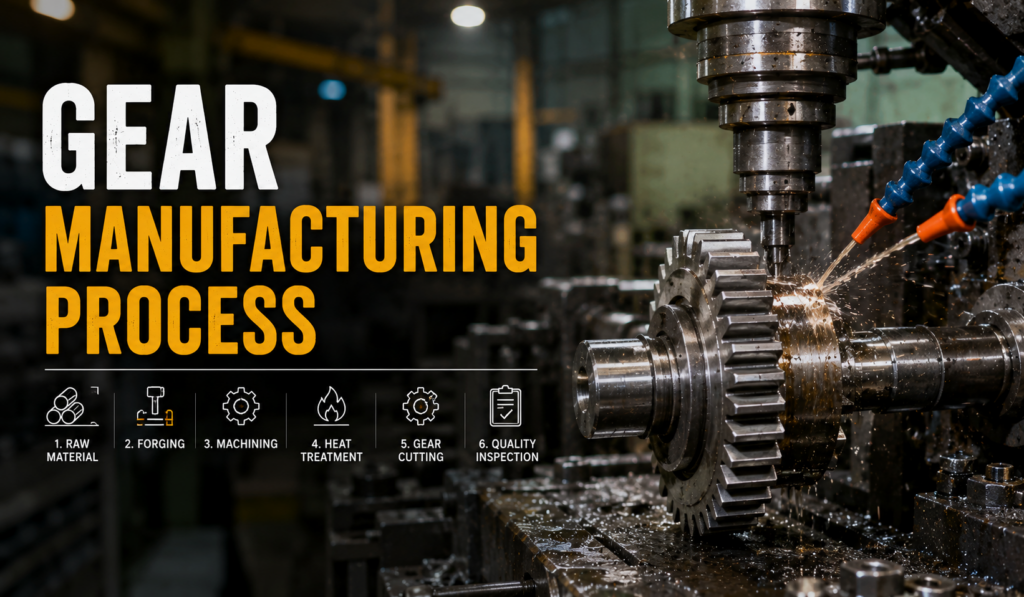
ToggleGear Manufacturing Process
Gears are among the most important mechanical components used in modern industrial equipment. From wind turbines and mining machinery to industrial gearboxes, construction equipment, cranes, and slewing ring bearings, gears must withstand continuous loads, torque, vibration, and demanding operating conditions.
Producing a reliable gear involves much more than simply cutting teeth into a metal blank. The manufacturing journey starts with raw material selection and continues through forging, heat treatment, machining, gear cutting, inspection, and finishing.
For large industrial gears, forged and rolled components can play a particularly important role. A properly manufactured Seamless Rolled Ring can provide the material integrity and favorable grain flow needed for demanding gear applications.
In this guide, we explain the complete gear manufacturing process, from raw material to finished component, and explore how Rolled Ring Manufacture supports large-diameter industrial gears and bearing applications.
What Is Gear Manufacturing?
Gear manufacturing is the process of converting metal stock or a forged preform into a precision component with accurately formed teeth designed to transmit motion and torque between rotating shafts.
Depending on the gear type, application, material, size, and required production volume, manufacturers may use a combination of:
- Forging
- Ring rolling
- Turning
- Gear hobbing
- Gear shaping
- Gear milling
- Heat treatment
- Grinding
- Honing
- Surface finishing
- Dimensional inspection
- Non-destructive testing
The objective is to produce gears with the required strength, accuracy, hardness, fatigue resistance, and service life.
Why Gear Manufacturing Quality Matters
Gears frequently operate under high mechanical loads. A manufacturing defect or dimensional error can result in:
- Excessive vibration
- Noise
- Tooth wear
- Pitting
- Premature fatigue
- Reduced transmission efficiency
- Gear tooth breakage
- Unplanned equipment downtime
This makes material selection and manufacturing process control particularly important for gears used in heavy engineering applications.
For large gears used in wind turbines, mining equipment, industrial gearboxes, and Slewing Ring Bearings, manufacturers must carefully control both the metallurgical and dimensional properties of the component.
Gear Manufacturing Process: Step-by-Step
The exact manufacturing route depends on the gear design, but a typical industrial process follows several important stages.
1. Raw Material Selection
The first step is selecting a material that can withstand the expected operating conditions.
Common gear materials include:
- Carbon steels
- Alloy steels
- Case-hardening steels
- Stainless steels
- Specialized engineering alloys
Material selection depends on factors such as:
- Applied torque
- Gear speed
- Contact stress
- Bending loads
- Fatigue requirements
- Operating temperature
- Corrosion exposure
- Required surface hardness
For large industrial gears, forged steel is often preferred when high structural integrity and fatigue performance are required.
2. Raw Material Inspection
Before manufacturing begins, the incoming material is inspected to confirm that it meets the specified requirements.
Typical checks may include:
Chemical Composition
Confirms that the material contains the required alloying elements.
Ultrasonic Testing
Can identify internal discontinuities in suitable raw material.
Dimensional Inspection
Confirms that the starting material meets required dimensions.
Material Traceability
Ensures the material can be tracked throughout the manufacturing process.
This initial quality control step helps prevent unsuitable material from entering production.
3. Cutting and Billet Preparation
The raw material is cut into the required size and weight for the forging operation.
Accurate billet preparation is important because incorrect material volume can lead to:
- Underfilling
- Excessive flash
- Uneven deformation
- Material wastage
For large ring gears, the material preparation process may be followed by forging and piercing before ring rolling.
4. Heating the Material
The prepared material is heated to an appropriate forging temperature.
Controlled heating is essential because the material must be sufficiently ductile to deform without developing defects.
Important parameters include:
- Heating temperature
- Heating rate
- Soaking time
- Temperature uniformity
- Furnace atmosphere
Improper heating can contribute to oxidation, excessive grain growth, cracking, or inconsistent material properties.
5. Forging the Gear Blank
After heating, the material is forged into a preliminary shape.
Forging applies controlled compressive forces to refine the material structure and develop the required geometry.
Depending on the component, manufacturers may use:
- Open-die forging
- Closed-die forging
- Press forging
- Hammer forging
For large industrial gears, forging can help establish a strong material structure before subsequent machining and heat treatment.
6. Ring Rolling for Large Gear Components
Large-diameter gears often require a different manufacturing route from small or medium-sized gears.
For ring gears, a forged and pierced preform can undergo ring rolling to increase its diameter while controlling wall thickness.
This process is central to Rolled Ring Manufacture.
The basic sequence can be described as:
Forging → Piercing → Ring Rolling → Heat Treatment → Machining → Gear Cutting → Inspection
The ring rolling process can produce a Seamless Rolled Ring with continuous material around the circumference.
This is particularly useful for large components where structural integrity and fatigue performance are critical.
Gear Tooth Manufacturing
The next major stage is creating the gear teeth.
Several methods can be used depending on the gear type and production requirements.
Gear Hobbing
Hobbing uses a rotating cutting tool called a hob to generate gear teeth.
It is widely used for producing:
- Spur gears
- Helical gears
- Sprockets
- Other cylindrical gear forms
Gear Shaping
Gear shaping uses a reciprocating cutter to generate gear teeth.
It can be useful for:
- Internal gears
- External gears
- Components where hobbing is not suitable
Gear Milling
Gear milling uses individual cutters to machine the tooth spaces.
It can be useful for specialized, low-volume, or large gear components.
Gear Grinding
Grinding provides highly accurate tooth geometry and improved surface finish.
It is generally used when demanding precision and performance requirements justify the additional finishing operation.
Non-Destructive Testing in Gear Manufacturing
Non-destructive testing allows manufacturers to evaluate components without damaging them.
Ultrasonic Testing
Used to identify internal discontinuities within suitable forged materials.
Magnetic Particle Inspection
Can identify surface and near-surface defects in ferromagnetic materials.
Visual Inspection
Used to identify visible surface defects, machining issues, and other irregularities.
Combining multiple inspection techniques provides greater confidence in the quality of the finished gear.
Gear Manufacturing for Slewing Ring Bearing Applications
One important application of large ring gears is the Slewing Ring Bearing.
A slewing ring bearing is designed to support heavy axial and radial loads while allowing controlled rotation. Some configurations incorporate gear teeth into the bearing ring to enable external or internal drive mechanisms.
These components can be used in:
- Cranes
- Excavators
- Wind turbines
- Construction equipment
- Material handling machinery
- Industrial rotating platforms
The gear teeth in these applications must maintain accurate geometry and withstand repeated mechanical loads.
This makes the quality of the underlying ring particularly important.
A high-integrity Seamless Rolled Ring can provide a strong foundation for manufacturing large bearing rings and gear components when the application and design call for this manufacturing route.
Common Challenges in Gear Manufacturing
Despite advanced manufacturing technology, gear production requires careful process control.
Common challenges include:
Material Defects
Inclusions or internal discontinuities can affect component performance.
Heat Treatment Distortion
Uneven heating or cooling can cause dimensional changes.
Gear Tooth Errors
Incorrect cutting parameters can affect tooth profile, pitch, and alignment.
Surface Defects
Cracks, grinding burns, or machining marks can reduce fatigue performance.
Dimensional Variations
Large ring components can experience distortion during forging, heat treatment, and machining.
Experienced manufacturers use process monitoring, simulation, inspection, and quality assurance systems to minimize these risks.
Why Akron Ring Forge for Rolled Ring Manufacturing?
Akron Ring Forge specializes in engineered rolled ring solutions for demanding industrial applications.
Our expertise in Rolled Ring Manufacture supports applications where material integrity, strength, dimensional consistency, and reliability are essential.
Our capabilities are suited to components used in industries such as:
- Heavy engineering
- Wind energy
- Mining
- Power generation
- Industrial machinery
- Bearing applications
- Construction equipment
From forged preforms to precision-machined ring components, the manufacturing process can be developed around the technical requirements of the application.
If your project requires a Seamless Rolled Ring, large-diameter gear ring, or forged ring component, Akron Ring Forge can work with your engineering and procurement teams to understand the required material, dimensions, tolerances, and performance specifications.
Final Thoughts
The gear manufacturing process involves a carefully controlled sequence of material selection, inspection, forging, ring rolling, heat treatment, machining, tooth cutting, finishing, and quality inspection.
For smaller gears, conventional forging and machining processes may be appropriate. For large-diameter industrial gear rings, however, a forged and rolled approach can provide important advantages in structural integrity, material utilization, and mechanical performance.
A properly manufactured Seamless Rolled Ring can serve as an important starting point for large gear rings and components used in demanding applications, including Slewing Ring Bearings, wind turbines, cranes, mining equipment, and heavy industrial machinery.
Choosing an experienced manufacturer with expertise in forging, ring rolling, heat treatment, machining, and inspection is therefore essential for achieving reliable gear performance.
Frequently Asked Questions
What are the main steps in gear manufacturing?
The main steps typically include raw material selection, material inspection, cutting, heating, forging, ring rolling where applicable, heat treatment, machining, gear cutting, finishing, and final inspection.
Why is forging used in gear manufacturing?
Forging can improve the material’s structural integrity and mechanical properties by producing favorable grain flow and reducing certain defects associated with other manufacturing methods.
What is a Seamless Rolled Ring?
A Seamless Rolled Ring is a forged ring produced through controlled deformation and ring rolling without joining separate sections by welding. It is used in many demanding industrial applications.
What is Rolled Ring Manufacture?
Rolled Ring Manufacture is a process in which a forged and pierced ring preform is progressively rolled to increase its diameter while controlling wall thickness and ring geometry.
Are seamless rolled rings used for gear manufacturing?
Yes. Seamless rolled rings can be used as the basis for large industrial gear rings where the required design and manufacturing specifications favor a forged and ring-rolled construction.
What is a Slewing Ring Bearing?
A Slewing Ring Bearing is a large-diameter bearing designed to support axial loads, radial loads, and overturning moments while allowing controlled rotational movement. Some designs incorporate integral gear teeth.
What industries use large forged gears?
Large forged gears and gear rings are used in wind energy, mining, construction equipment, power generation, marine systems, heavy engineering, material handling, and industrial machinery.
How do I choose the right gear manufacturing process?
The choice depends on gear size, material, geometry, production quantity, load requirements, accuracy, fatigue requirements, heat treatment, and application. An experienced forging and ring manufacturing partner can help determine the appropriate manufacturing route.
Pingback: Gear Manufacturing Process: Raw Material to Finished Component