Table of Contents
ToggleIntroduction Closed Die Forging
In heavy engineering industries, component failure is never a small issue. Whether it’s a wind turbine, mining machine, hydraulic press, crane, gearbox, or a large slewing ring bearing, the performance of every critical part directly affects safety, productivity, and long-term operating costs. That’s why manufacturers across industrial sectors rely on forging processes that deliver high strength, dimensional consistency, and dependable performance under extreme loads.
One of the most trusted manufacturing methods for this purpose is closed die forging.
From automotive and aerospace to power generation, marine, railways, oil & gas, and heavy equipment manufacturing, closed die forging plays a vital role in producing high-strength industrial components with better grain flow, reduced defects, and improved mechanical properties. For businesses looking to source precision-engineered components, understanding this process is essential — especially when working with experienced Rolled Ring Manufacturers that also supply forged parts and seamless rolled ring solutions for critical applications.
This complete guide explains what closed die forging is, how it works, its advantages, limitations, industrial applications, and why it matters in heavy engineering industries.
What Is Closed Die Forging?
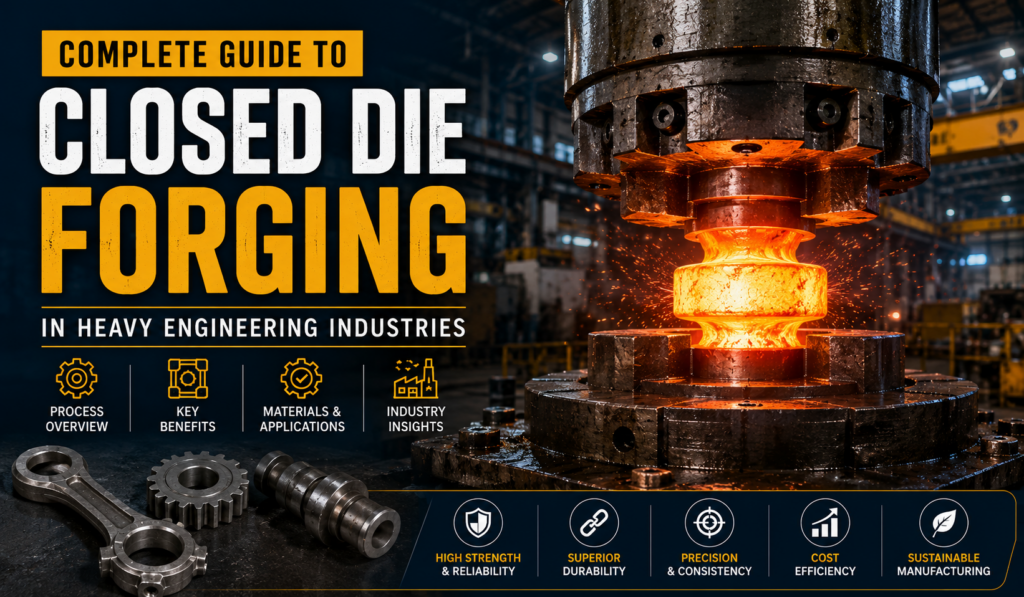
Closed die forging, also known as impression die forging, is a forging process in which heated metal is placed between two dies that contain a pre-shaped cavity. When compressive force is applied, the metal flows into the die cavities and takes the required shape.
Unlike open die forging, where metal is deformed between flat or simple dies, closed die forging uses custom-designed tooling to create more precise and complex shapes.
The process is widely used to manufacture:
- Gear blanks
- Shafts
- Hubs
- Flanges
- Crank components
- Bearing rings
- Couplings
- Structural forged parts
- Components used in slewing ring bearings
- Preforms for seamless rolled rings and other engineered ring products
Closed die forging is especially suitable for parts that need high strength, repeatability, and controlled dimensions.
How Closed Die Forging Works
The process may vary depending on component design, material grade, and production volume, but the general workflow is similar across most heavy engineering applications.
- Raw Material Selection
The process begins with selecting the right metal billet or bar based on the component’s application, load conditions, and mechanical requirements. Common materials include:
- Carbon steel
- Alloy steel
- Stainless steel
- Nickel alloys
- Special engineered grades
- Heating the Metal
The raw material is heated to a specific forging temperature to improve ductility and allow controlled deformation.
- Placing the Material in the Die
The heated billet is placed inside the lower die cavity. The upper die then closes under high pressure.
- Metal Flow and Shape Formation
As force is applied, the metal flows into the impression of the die and fills the cavity, taking the desired shape.
- Flash Formation
Excess material may flow out around the die parting line, creating what is known as flash. This flash is later trimmed.
- Trimming and Finishing
After forging, the part may go through trimming, heat treatment, shot blasting, machining, inspection, and testing depending on final specifications.
The result is a forged component with excellent strength, structural integrity, and improved mechanical performance compared to cast or fabricated alternatives.
Why Closed Die Forging Matters in Heavy Engineering Industries
Heavy engineering components are often exposed to:
- High loads
- Shock and vibration
- Harsh weather conditions
- Repetitive stress cycles
- Extreme pressure or temperature
- Safety-critical operating environments
In such cases, the manufacturing process must produce parts that can handle demanding real-world conditions without premature failure.
Closed die forging is preferred because it offers:
- Superior grain structure
- Higher strength than cast parts
- Better fatigue resistance
- Improved impact toughness
- Good dimensional repeatability
- Lower risk of internal voids and porosity
This makes it a reliable process for components used in cranes, turbines, mining systems, marine equipment, industrial presses, gearboxes, and bearing assemblies.
Closed Die Forging vs Open Die Forging
Many buyers researching industrial forgings want to understand the difference between closed die forging and open die forging.
Closed Die Forging
- Uses shaped dies with impressions
- Suitable for medium to high-volume production
- Produces more precise shapes
- Better for complex geometries
- Lower machining requirement in many cases
- Good repeatability and consistency
Open Die Forging
- Uses flat or simple dies
- Better for very large, simple parts
- Offers more flexibility for oversized components
- Often requires more machining after forging
- Suitable for low-volume custom heavy parts
In short, closed die forging is generally the better option when the component requires tighter dimensional control, higher repeatability, and a more refined shape.
Key Advantages of Closed Die Forging
- High Strength and Structural Integrity
Forging improves grain flow in the direction of the component’s geometry, resulting in stronger parts with better load-bearing capability.
- Better Dimensional Consistency
Since the material is shaped inside a defined die cavity, the final part is more consistent than parts produced through less controlled forming methods.
- Improved Fatigue Resistance
Heavy engineering components often operate under repeated stress. Closed die forging enhances fatigue performance, making it ideal for rotating and load-bearing parts.
- Reduced Risk of Defects
Compared to casting, forged parts typically have fewer internal voids, shrinkage issues, or porosity-related defects.
- Efficient Material Use for Repetitive Production
Once tooling is developed, the process is efficient for producing repeat parts with reliable quality.
- Suitable for Complex Shapes
Closed die forging can produce components with contours and features that would be difficult to achieve through open die forging alone.
Limitations of Closed Die Forging
Like every manufacturing process, closed die forging has its limitations too.
- Higher Tooling Cost
Custom dies are required for each part geometry, which increases the initial setup cost.
- Less Economical for Very Low Volumes
For one-off or very small batches, tooling investment may not be justified unless the part is highly critical.
- Size Constraints
Extremely large components may be better suited to open die forging depending on equipment and geometry.
- Design Restrictions
Although closed die forging handles complex shapes well, there are still design considerations related to draft angles, flash control, and material flow.
That said, for medium to high-volume heavy engineering parts, the benefits usually outweigh these limitations.
Closed Die Forging in Slewing Ring Bearing Manufacturing
One of the most important applications in heavy engineering is the production of components for slewing ring bearings.
Slewing ring bearings are used in:
- Cranes
- Excavators
- Wind turbines
- Construction equipment
- Material handling systems
- Rotating platforms and industrial turntables
These bearings must support heavy axial, radial, and moment loads while maintaining smooth rotation over long operating cycles.
Because of these demands, forged bearing components must deliver:
- High strength
- Good dimensional stability
- Reliable fatigue performance
- Low defect risk
- Long service life under harsh conditions
Closed die forging can be used to manufacture preforms and structural parts that later contribute to the bearing assembly. In applications where ring geometry is critical, forged blanks may also feed into ring rolling operations to create high-integrity bearing rings.
Closed Die Forging vs Casting for Heavy Engineering Parts
A common sourcing question is whether a component should be forged or cast.
Forged Components
- Better mechanical properties
- Stronger grain flow
- Higher impact resistance
- Lower risk of internal porosity
- Better fatigue life
Cast Components
- Suitable for very complex shapes
- Lower tooling investment for some designs
- Can be economical for specific non-critical applications
For load-bearing, safety-critical, and fatigue-sensitive heavy engineering parts, forged components are usually the preferred choice.
Why Akron Ring Forge Is a Trusted Partner for Forged Ring Solutions
At Akron Ring Forge, we understand that industrial buyers are not just looking for a forged component — they are looking for reliability, long service life, and a manufacturing partner that understands demanding applications.
Our expertise in seamless rolled rings and industrial forged components allows us to support sectors where precision, strength, and performance matter most.
We work with customers across heavy engineering applications to deliver:
- High-quality forged ring solutions
- Custom seamless rolled ring manufacturing
- Support for components used in slewing ring bearings
- Material-focused engineering for demanding load conditions
- Consistent quality and dimensional reliability
Whether your requirement involves forged rings, bearing applications, rotating equipment, or custom heavy-duty industrial components, Akron Ring Forge is built to support long-term performance and dependable supply.
Final Thoughts
Closed die forging remains one of the most important manufacturing processes in heavy engineering industries because it combines strength, repeatability, and reliability in a way few other methods can match. For components exposed to heavy loads, fatigue, impact, and harsh service conditions, forged parts often deliver a clear performance advantage over fabricated or cast alternatives.
And when applications involve large rings, rotating systems, or bearing assemblies, working with experienced Rolled Ring Manufacturers becomes even more important. The right manufacturing partner can help you select the best forging route, improve component performance, and reduce long-term operational risk.
If your business needs forged industrial rings, seamless rolled rings, or components for slewing ring bearings, partnering with a specialist manufacturer can make a measurable difference in quality and reliability.
Frequently Asked Questions
What is closed die forging?
Closed die forging is a manufacturing process in which heated metal is compressed between shaped dies to create a specific component geometry with improved strength and consistency.
Why is closed die forging used in heavy engineering?
It is used because it produces strong, reliable parts with good grain flow, fatigue resistance, and dimensional repeatability — all critical for heavy-duty industrial applications.
What is the difference between closed die forging and open die forging?
Closed die forging uses impression dies to create more precise and repeatable shapes, while open die forging is better suited for simpler, very large parts with less complex geometry.
Is closed die forging better than casting?
For many load-bearing and fatigue-critical industrial components, closed die forging is often better because it provides improved mechanical properties and fewer internal defects.
Can closed die forging be used for slewing ring bearing components?
Yes. Closed die forging is used for certain bearing components and preforms, while ring rolling may be used for large ring sections depending on the design and application.
What industries use closed die forged components?
Heavy engineering, automotive, aerospace, power generation, oil & gas, marine, railways, mining, wind energy, and construction equipment all use closed die forged parts.
How do Rolled Ring Manufacturers support heavy engineering industries?
Rolled Ring Manufacturers produce high-strength seamless rolled rings used in bearing systems, flanges, wind energy components, and other critical industrial applications where performance and reliability matter.