
Table of Contents
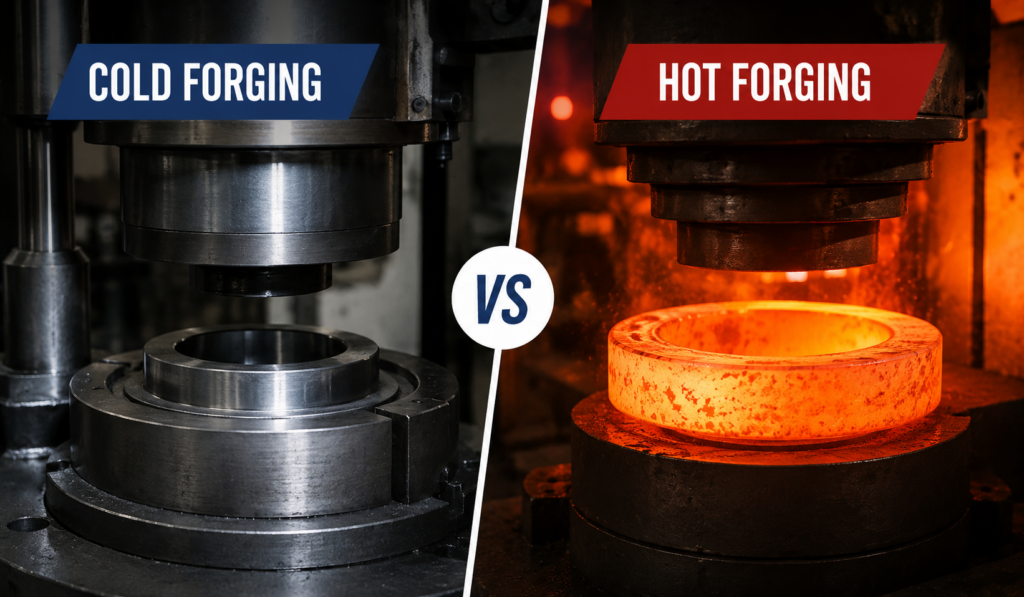
ToggleCold forging vs. Hot Forging
When it comes to manufacturing durable and high-performance industrial components, forging remains one of the most trusted and efficient metalworking processes. From automotive parts and aerospace components to heavy machinery and slewing ring bearings, forged parts are valued for their strength, structural integrity, and long service life.
However, one important question often arises for OEMs, procurement teams, and industrial buyers: cold forging vs hot forging — which process is better for industrial components?
The answer depends on the component’s size, complexity, mechanical requirements, material type, and end-use application. In this guide, we’ll break down the differences between cold forging and hot forging, compare their benefits and limitations, and explain where each process works best. We’ll also look at why experienced Rolled Ring Manufacturers play a critical role in producing high-performance forged components for demanding industries.
What Is Forging in Manufacturing?
Forging is a metal shaping process where compressive force is applied to metal to form a desired shape. Unlike casting or fabrication, forging improves the internal grain structure of the material, which results in stronger and more reliable parts.
Forging is widely used for manufacturing:
- Industrial flanges
- Shafts and gears
- Bearing rings
- Heavy machinery components
- Aerospace parts
- Wind energy components
- Seamless rolled rings
- Components for slewing ring bearings
The two most common forging methods are cold forging and hot forging.
What Is Cold Forging?
Cold forging is the process of shaping metal at or near room temperature using high pressure. In this method, the material is not heated to its recrystallization temperature before deformation.
Cold forging is commonly used for:
- Fasteners
- Small automotive parts
- Bushings
- Pins
- Small precision components
- Certain high-volume industrial parts
Because the material is forged without heating, cold forging often produces excellent surface finish and dimensional accuracy.
What Is Hot Forging?
Hot forging is the process of shaping metal after heating it above its recrystallization temperature. Heating makes the metal more ductile and easier to deform, allowing manufacturers to produce larger, stronger, and more complex parts.
Hot forging is widely used for:
- Large industrial rings
- Gear blanks
- Flanges
- Turbine components
- Pressure vessel parts
- Mining and heavy engineering components
- Seamless rolled rings
- Components used in slewing ring bearings
For industries that need large-scale, high-strength, or custom-shaped parts, hot forging is often the preferred process.
Cold Forging vs Hot Forging: Key Differences
Understanding the difference between these two processes helps buyers choose the right manufacturing method for their application.
- Temperature of Processing
Cold Forging
Cold forging is done at room temperature or slightly elevated temperatures.
Hot Forging
Hot forging is performed at high temperatures, typically above the metal’s recrystallization point.
Why it matters:
Temperature directly affects formability, grain structure, dimensional tolerance, tooling wear, and final mechanical properties.
- Component Size and Complexity
Cold Forging
Cold forging is generally suitable for:
- Small to medium-sized parts
- Simple to moderately complex shapes
- High-volume production runs
Hot Forging
Hot forging is ideal for:
- Large industrial components
- Thick cross-sections
- Complex geometries
- Heavy-duty forged rings and custom parts
Winner for large industrial components: Hot forging
- Strength and Mechanical Performance
Both processes can produce strong parts, but the way they achieve strength differs.
Cold Forging
Cold forging increases strength through strain hardening. It can improve hardness and tensile strength, especially in smaller components.
Hot Forging
Hot forging refines grain flow and allows deep deformation without cracking. It is better suited for critical structural components that need toughness, fatigue resistance, and long-term durability.
For heavy engineering applications, hot forging often provides a better balance of:
- Strength
- Toughness
- Impact resistance
- Structural integrity
- Surface Finish and Dimensional Accuracy
Cold Forging
Cold forging usually offers:
- Better surface finish
- Tighter tolerances
- Less post-processing
- Better repeatability in mass production
Hot Forging
Hot forging may require:
- Machining
- Surface finishing
- Heat treatment
- Additional processing to achieve final tolerances
Winner for precision small parts: Cold forging
- Material Flow and Defect Resistance
Cold Forging
Since the material is less ductile at room temperature, cold forging is limited by the force required and the risk of cracking in more difficult shapes.
Hot Forging
Hot forging allows the material to flow more easily, making it suitable for larger and more complex components. It also reduces internal voids and improves the metallurgical structure when done correctly.
This is one reason Rolled Ring Manufacturers often rely on hot forging as the base process for producing large seamless rolled rings and components for slewing ring bearings.
- Tooling and Production Costs
Cold Forging
Cold forging is highly efficient for high-volume production. Once tooling is developed, the per-part cost can be low for smaller components.
Hot Forging
Hot forging generally requires:
- Furnaces or induction heating
- More energy
- Larger equipment
- Additional finishing operations
However, for large industrial components, hot forging is often more practical and cost-effective than trying to machine the part from a solid block.
Advantages of Cold Forging
Cold forging offers several benefits for suitable applications:
- Excellent Dimensional Accuracy
Cold-forged parts often need less machining, reducing overall production time and cost.
- Better Surface Finish
Since the material is not heated, oxidation and scale formation are minimized.
- High Production Speed
Cold forging is ideal for mass production of small, repeatable components.
- Material Savings
Near-net-shape production reduces waste.
- Increased Strength through Work Hardening
Some components benefit from the added hardness created during cold forming.
Limitations of Cold Forging
Cold forging is not ideal for every industrial application.
- Limited to Smaller Components
Very large or thick parts are difficult to forge at room temperature.
- Higher Forming Loads
More force is required to deform metal without heat.
- Shape Restrictions
Complex geometries and deep deformations can be challenging.
- Material Limitations
Some alloys are less suitable for cold forging due to lower ductility.
Advantages of Hot Forging
Hot forging is the preferred method for many industrial applications because of its versatility and mechanical benefits.
- Ideal for Large Components
Hot forging can produce heavy-duty industrial parts that are difficult or impossible to cold forge.
- Better Formability
Heated metal flows more easily, enabling more complex shapes and larger reductions.
- Stronger Grain Flow
The forging process aligns the grain structure, improving fatigue resistance and toughness.
- Suitable for a Wide Range of Alloys
Hot forging works well with carbon steel, alloy steel, stainless steel, and specialty metals.
- Perfect for Seamless Rolled Rings
Large rings used in energy, mining, heavy engineering, and slewing ring bearings are typically produced through hot forging followed by ring rolling.
Limitations of Hot Forging
Like any manufacturing process, hot forging also has trade-offs.
- Additional Finishing May Be Needed
Machining and heat treatment are often required to achieve final specifications.
- Surface Oxidation
Heating can cause scale formation and surface imperfections.
- Higher Energy Consumption
The process requires heating equipment and energy input.
- Slightly Wider Tolerances
Compared to cold forging, hot forging may not deliver the same as-forged dimensional precision.
Which Is Better for Industrial Components?
There is no one-size-fits-all answer. The better process depends on the application.
Choose Cold Forging When:
- The component is small to medium-sized
- High-volume production is needed
- Tight tolerances are critical
- Surface finish matters
- The geometry is relatively simple
- The material can withstand room-temperature deformation
Choose Hot Forging When:
- The part is large, thick, or heavy-duty
- The component requires high structural strength
- The shape is complex
- Toughness and fatigue resistance are essential
- The application involves harsh operating conditions
- The component will be used in heavy engineering, power, mining, wind, or bearing systems
For most large industrial components, hot forging is the better choice.
Final Verdict: Cold Forging vs Hot Forging
If you’re manufacturing small precision parts at scale, cold forging can be a highly efficient and cost-effective option.
But if you need large, durable, structurally strong industrial components, especially for heavy engineering, seamless rolled rings, and slewing ring bearings, hot forging is usually the better choice.
The key is not just choosing cold forging or hot forging — it’s choosing the right process for your exact application, material, performance requirement, and operating environment.
Frequently Asked Questions
What is the main difference between cold forging and hot forging?
Cold forging is performed at or near room temperature, while hot forging is done after heating the metal above its recrystallization temperature.
Which process is stronger: cold forging or hot forging?
Both can produce strong components, but hot forging is generally better for large industrial parts that require toughness, fatigue resistance, and deep structural integrity.
Is cold forging cheaper than hot forging?
Cold forging can be more economical for high-volume small parts. Hot forging is often more cost-effective for large or complex industrial components.
Why is hot forging preferred for seamless rolled rings?
Hot forging improves material flow and allows large ring preforms to be shaped efficiently before ring rolling, resulting in strong, high-integrity seamless rings.
Are slewing ring bearings made using forged rings?
Yes. Many slewing ring bearings use forged and rolled rings because they need high strength, dimensional stability, and long service life under heavy loads.
How do I choose the right rolled ring manufacturer?
Look for a manufacturer with forging expertise, advanced ring rolling capabilities, strict quality control, material knowledge, and experience in industrial applications.
Can Akron Ring Forge manufacture custom rolled rings?
Yes. Akron Ring Forge provides custom seamless rolled ring solutions tailored to industrial applications, dimensions, materials, and performance requirements.