
Table of Contents
ToggleLow-Quality Forged Rings
In industries like wind energy, automotive, heavy machinery, and oil & gas, forged rings play a critical role in ensuring structural strength, load-bearing capacity, and long-term reliability. However, not all forged rings are created equal.
Using low-quality forged rings can lead to unexpected failures, costly downtime, and safety risks. For engineers, procurement teams, and plant managers, identifying early warning signs is essential.
Here are the 5 key warning signs of low-quality forged rings you should never ignore.
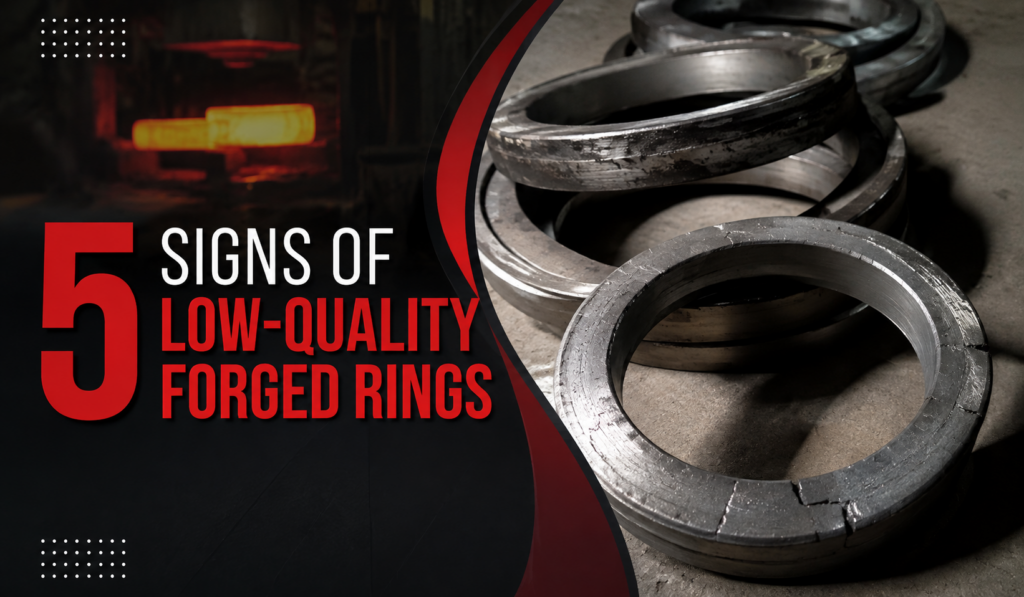
1. Surface Cracks and Visible Defects
One of the most obvious indicators of poor-quality forging is visible surface imperfections.
What to look for:
- Hairline cracks
- Laps and seams
- Scale pits or uneven surfaces
Why it matters:
These defects often occur due to improper forging temperatures or poor material handling. Even minor cracks can propagate under stress, leading to catastrophic failure in critical applications.
2. Inconsistent Material Properties
High-quality forged rings should have uniform mechanical properties throughout the structure. If not, it’s a major red flag.
Signs of inconsistency:
- Uneven hardness across the ring
- Variations in tensile strength
- Poor impact resistance
Root cause:
This usually results from improper heat treatment or non-uniform cooling, which weakens the overall integrity of the ring.
Explore More: Introducing Akron Ring Forge
3. Dimensional Inaccuracy and Poor Machining
Precision is crucial in industrial equipment. Low-quality forged rings often fail to meet tight tolerances.
Warning indicators:
- Out-of-round shapes
- Improper inner/outer diameters
- Misalignment during assembly
Impact:
Dimensional errors can cause:
- Excessive vibration
- Misalignment in rotating systems
- Increased wear on connected components
4. Premature Wear and Fatigue Failure
If a forged ring shows signs of wear earlier than expected, it’s a clear indication of substandard quality.
Common symptoms:
- Surface pitting or spalling
- Cracks under cyclic loads
- Reduced load-bearing capacity
Why this happens:
Low-quality raw materials or poor forging processes reduce fatigue strength, making the component unsuitable for high-load and dynamic environments.
5. Poor Grain Structure and Internal Defects
The internal structure of a forged ring determines its performance. High-quality forging ensures a refined and directional grain flow, enhancing strength.
Signs of poor internal quality:
- Inclusion defects
- Voids or porosity
- Non-uniform grain flow
Risk factor:
These hidden defects are dangerous because they may not be visible externally but can cause sudden and unexpected failures under stress.
Why Choosing the Right Forging Partner Matters
The quality of forged rings depends heavily on the manufacturer’s expertise, technology, and quality control processes.
At Millennium Rings, we focus on:
- Advanced seamless rolled ring forging technology
- Strict quality inspection and testing
- Consistent material properties and precision machining
- Customized solutions for critical industrial applications
This ensures every ring delivers maximum strength, durability, and reliability in demanding environments.
Final Thoughts
Low-quality forged rings may seem cost-effective initially, but they often result in:
- Higher maintenance costs
- Unexpected downtime
- Safety risks
By identifying these warning signs early and partnering with a trusted manufacturer like Millennium Rings, you can ensure long-term performance and operational efficiency.
Need High-Quality Forged Rings for Your Application?
Millennium Rings provides precision-engineered solutions tailored for industries like wind energy, heavy machinery, and automotive.